Google's Gemini Decisions API Compared with OpenAI, Upstage, TypeSafe, and Open-Source Strands Decider
Key Takeaway
Google released the Gemini Decisions API on November 11, 2026. It doesn't write an answer. It returns a probability for each option you define. OpenAI and Upstage have similar APIs.
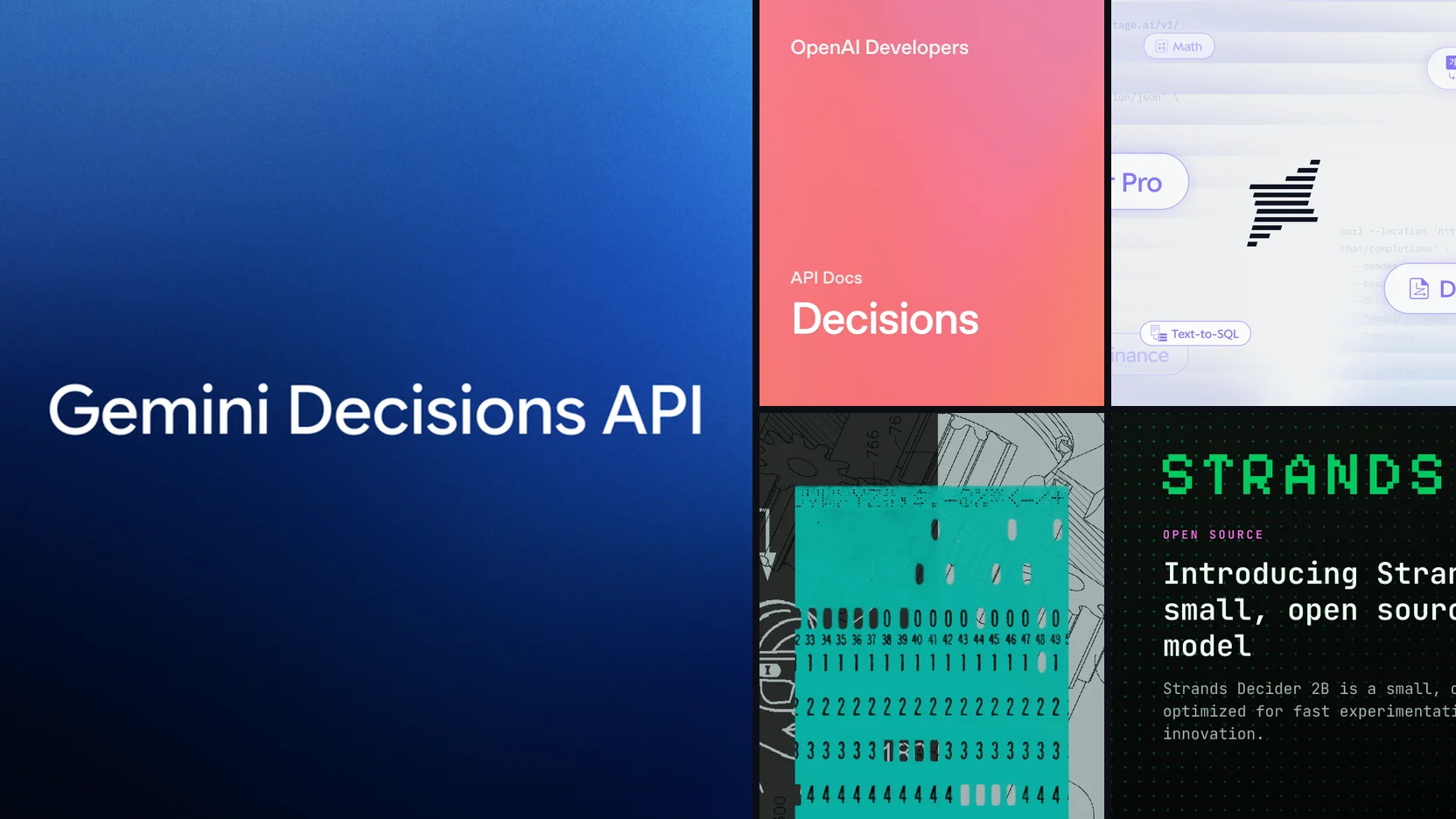
TypeSafe has Jev, and Strands Decider 2B is an open-source model you can run yourself. Every detail in this article comes from official documents.
What is a Decisions API?
A normal generative API produces text one token at a time. A Decisions API doesn't. You give it a question and a set of options, and it scores every option in a single computation and returns probabilities and a confidence score. No text is generated, so responses are fast and there's no output-token cost.
It fits tasks with a closed answer space: routing a request to a model or tool, checking content against a policy, or grading whether a search result is useful for a question.
What stands out in Google's Gemini Decisions API?
Google's blog says the model is gemini-decision-1, available through the Gemini API and Google AI Studio.
- Question types: yes or no, a choice among 2 to 255 options, or a score against an ordered rubric.
- Input: a single request can mix text, images, audio, video, and PDFs, up to 256K tokens. It can also hold up to 1,000 independent questions, and the shared input is processed once.
- Speed: Google states 150 to 250 ms end to end. For model compute alone it gives a median of 50 to 100 ms, nearly flat from 1 to 100 questions with inputs up to 16K tokens.
- Price: $0.10 per million input tokens, and no output charge. AI Studio has a free tier for prototyping.
- Integrations: OpenRouter, LangChain, Vercel, LiteLLM, Pydantic AI, Pipecat, LiveKit and OpenCode are listed. Google Cloud support is described as coming soon.
- Performance claims: Google says it has the lowest calibration error on its suite of agent routing, reasoning, ranking and multimodal tasks, and is nearly 5 times cheaper than Gemini 3.5 Flash-Lite on the same suite. These are Google's own figures, and nobody has verified them independently.
How do the other four differ?
OpenAI's Decisions API launched in beta on October 6 and reached general availability on October 22. The changelog says the per-request question limit rose from 200 to 400 that day. The only supported model is gpt-6-luna, at POST /v1/decisions. Inputs can be text, conversation history, images or JSON; audio and file IDs aren't supported. Uncached input costs $0.10 per million tokens, with no output charge. Cache reads are discounted, though regional processing or long context can add charges. OpenAI lists Zero Data Retention and HIPAA support for eligible customers, US and EEA plus Switzerland regional processing, and Private Link. On speed it says only that it's about 10 times faster than the Responses API. No millisecond figure.
Upstage Solar Decide shows up in Upstage's console docs as a beta released on September 22, 2026. The model is solar-decide at POST /v1/systemone. It handles choice, score, and yes or no questions. A choice question takes 2 to 26 options, and sending 27 returns a 422 error. Context is 512K, and inputs are text and JSON. Input costs $0.1 per million tokens; output is free. For speed, the docs give only a qualitative "Fast" label, with no milliseconds. They also say it's in beta and the schema may change before general availability. The listed access path is the Upstage Console.
TypeSafe Jev is TypeSafe's own model, and its docs list two versions: Jev 1.14 (available from October 14) and Jev 1.13. Question types are Choice, Score, Noul, and Box, but Box needs 1.14. Inputs are text and PNG or JPEG images. The default context is 64K per request and 32K per question; a long-context header raises it to 262K. Input costs $0.042 per million tokens, with no output charge. TypeSafe states 70 to 500 ms. Rate limits are set per organization in the console.
Strands Decider 2B is an open-source model that AWS Strands Labs released on October 1. It has about 1.9 billion parameters and is built on Qwen3.5-2B-Base, and both the code and the weights are licensed under Apache-2.0. You install it with pip install strands-decider, then either ask questions from the CLI or start a local server with the serve command and call POST /v1/systemone. Questions come in three types, yes or no, choice, and score, and the repository says there's no numeric cap on options. Input is text by default, though the Qwen3.5 models accept images with a --vision option. For small tasks, the blog reports a median of about 115 ms on an RTX 3090 and about 153 ms on an M3 MacBook. The local server binds only to 127.0.0.1 and has no authentication, so if you expose it, you have to protect it yourself. I didn't find a hosted service or pricing in the official sources. The repository names v1 (strands-decider-2B-qwen3.5-v1-2610) as its current reference model, while the blog describes v19, so check the version before downloading. On JevBench, a third-party benchmark, the repository reports that v1 answered 180 of 231 public tasks correctly.
How do the five compare in a table?
| Item | Gemini | OpenAI | Upstage Solar Decide | TypeSafe Jev 1.14 | Strands Decider 2B |
|---|---|---|---|---|---|
| Released | Nov 11, 2026 | Beta Oct 6, GA Oct 22 | Beta Sep 22 | 1.14 from Oct 14 | Oct 1 |
| Delivery | API | API | API (beta) | API | Open source (self-run) |
| Inputs | Text, images, audio, video, PDF | Text, conversation, images, JSON | Text, JSON | Text, PNG, JPEG | Text (images optional) |
| Questions per request | Up to 1,000 | Up to 400 | No limit stated | Not found | Not found |
| Options per choice question | 2 to 255 | Not found | 2 to 26 | Not found | No numeric cap |
| Input size | 256K | Not found | 512K | 64K default, 262K extended | No model maximum stated |
| Price (per 1M input tokens) | $0.10 | $0.10 (varies with cache and region) | $0.1 | $0.042 | Model free (hosting extra) |
| Official speed statement | 150 to 250 ms | About 10x the Responses API | "Fast" label | 70 to 500 ms | About 115 ms (RTX 3090) |
The values come from each provider's official documents, and "Not found" means the information wasn't in the documents reviewed. None of this was measured under identical conditions, so test speed and accuracy on your own task.
Which one fits which situation?
- You need to judge audio, video, and PDFs together. Of the official documents reviewed, only the Gemini Decisions API lists them as inputs.
- You have retention, regional, or compliance requirements. OpenAI documents ZDR, HIPAA, regional processing, and Private Link. Google's announcement doesn't cover these, and Cloud support has only been announced.
- You want a Korean provider's API. Upstage Solar Decide is available, though it's in beta, the schema may change, and choices are capped at 26.
- You want the lowest unit price and your input is text and images. Among the APIs, Jev has the lowest listed price. Rate limits depend on your organization settings, so check them before you plan capacity.
- You want to keep data in-house and run it yourself. A model with downloadable weights, such as Strands Decider 2B, can run locally. But server operation and security become your job.
- You need to batch many questions at once. The per-request limit is 1,000 for Google and 400 for OpenAI.
What should you check before adopting one?
- Start by checking that your task really is a closed-set decision. If you need open-ended text, a regular generative API is the right tool.
- Run the same 100 to 200 questions through every candidate, then compare their accuracy and how well their confidence scores are calibrated.
- Go back to the official docs and confirm input formats, per-request question limits, and region and retention requirements. Limits and prices can change soon after a launch.
Frequently Asked Questions
How is a Decisions API different from a chat API?
It does not write an answer. It returns probabilities and a confidence score for options you define in advance. It is meant for closed-set work such as routing, policy checks, and classification, where speed and low cost matter.
How much do the prices differ?
Google, OpenAI, and Upstage list $0.10 per million input tokens with no charge for output tokens. TypeSafe lists $0.042 for Jev. Strands Decider is open source, so there is no model fee, only the cost of running your own server.
Which one accepts audio or video?
Among the official documents compared here, only the Gemini Decisions API lists audio, video, and PDF as inputs. OpenAI lists text, images, and JSON, Upstage lists text and JSON, and Jev lists text and PNG or JPEG images.
Can I run one on my own server?
Strands Decider 2B can be. Its code and weights are released under Apache-2.0, and you can install it with pip and use it from a CLI or a local HTTP server.
Sources & Verification Date
- Gemini Decisions API: Fast, calibrated multimodal decisions (Google blog) · Verified
- Decisions (OpenAI API guide) · Verified
- OpenAI API changelog · Verified
- Structured Decision API (Upstage console docs) · Verified
- Models (TypeSafe docs) · Verified
- Introducing Strands Decider 2B (Strands blog) · Verified
- strands-labs/strands-decider (GitHub) · Verified